

July - August 2026 Issue
HORN Bulletin - Vol IX • Iss IV
Authors
Abstract
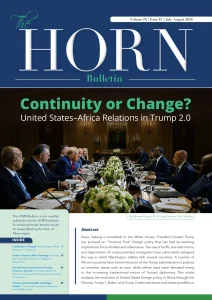
Since making a comeback to the White House, President Donald Trump has pursued an “America First” foreign policy that has had far-reaching implications for both allies and adversaries. The use of tariffs, visa restrictions, and deportation of undocumented immigrants have particularly reshaped the way in which Washington relates with several countries. A number of African countries have borne the brunt of the Trump administration’s policies on sensitive issues such as race, while others have been elevated owing to the increasing transactional nature of Trump’s diplomacy. This article analyses the evolution of United States foreign policy in Africa through the Obama, Trump 1, Biden, and Trump 2 administrations and draws parallels on the approaches of these administrations in areas of trade, development, and security. It highlights foreign policy changes during the Trump administration and what they mean for the future of United States–Africa relations. It concludes by recommending that African countries should adopt a multilateral approach to relations with major powers in order to balance diplomatic engagement and guard against exploitation.
In this issue:
Article 1: Women-Led Households in Refugee Camps: A Comparative Analysis of Kakuma and Dadaab Camps
Article 2: Hybrid Power Projection by Foreign Powers in Somalia: The Case of External Influence, Structural Entrenchment and Indirect Competition
Article 3: Continuity or Change? United States–Africa Relations in Trump 2.0
Article 4: Sudan in Russia’s Africa Strategy: The Red Sea, Strategic Interests, and Regional Competition