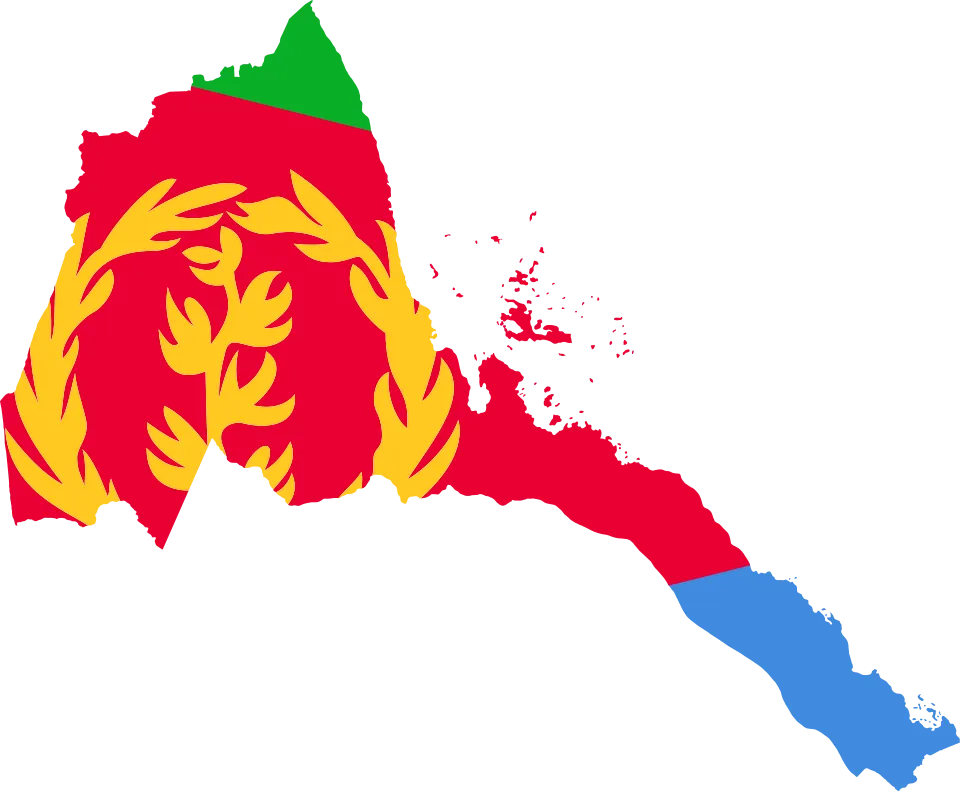
Eritrea
Capital | Asmara
Independence | 24 May 1993
Official Languages | Tigrinya, Arabic, English
~3.7 million
Population
117,600 km²
Total area
USD 3.1 billion
GDP
USD 860.1
GDP per Capita
Eritrean Nakfa (ERN)
Currency
Christianity and Islam
Main Religion
Membership to Regional Organisations
IGAD, AU, COMESA
Regional Significance
Eritrea holds strategic geopolitical significance in the Horn of Africa due to its location along the Red Sea, near the Bab el-Mandeb Strait, one of the world’s most critical maritime chokepoints linking the Red Sea to the Gulf of Aden and the Indian Ocean. This position gives it influence over key global shipping routes, while its regional relations with neighbouring states, particularly Ethiopia, continue to shape regional security dynamics, particularly around maritime access, and shifting alliances in the Horn of Africa.
Key Challenges
- Totalitarian one-party rule — no legislature, no elections, no free press
- Mass emigration driven by indefinite military conscription
- Complete absence of civil society, independent judiciary, or free media
- No succession plan — Afwerki's death without institutions risks severe instability
- Serious human rights violations documented by the UN Special Rapporteur (2025)
- Economic isolation — China is the only meaningful formal trade partner
Interesting Facts
Up to one-third of Eritrea’s population lives abroad — one of the highest per-capita emigration rates globally, driven by indefinite mandatory military service.