
Dr. Mustafa Y. Ali
Nairobi, Kenya
Special Paper No. 1; Generations of Terrorism: September 16, 2026
Abstract
This policy research paper proposes a five-generation framework for the study of terrorism that begins in antiquity rather than in the late nineteenth century. Generations are treated here not as a settled periodization but as an analytical device for tracing transformations in motive, organization, political purpose, and operational environment across more than two millennia of ideologically legitimized violence.
The first generation is localized ideological violence, illustrated by the Sicarii of first-century Judea and the Azariqa faction of the early Kharijites. The second is medieval religious-political violence and institutionalized asymmetry, exemplified by the Hashashins, or Assassins, of Persia and Syria. The third is imperial and colonial terrorism, in which violence from above terrorized colonial subjects resisting imperialism and colonialism. The fourth is the modern religious wave of transnational mobilization associated with the late twentieth century. The fifth, the paper’s principal claim, is a religio-political, networked, and increasingly autonomous era. Its distinguishing feature is not religion as such—religion already structured much fourth-generation terrorism—but a feedback loop in which theology, political strategy, local grievance, organizational self-financing, territorial influence, and digital communication reinforce one another. Violent non-state actors in this generation may function simultaneously as ideological movements, political competitors, economic enterprises, and proto-governments. The paper distinguishes terrorism from the act of terror, extremism, violent extremism, and radicalism, and argues that counterterrorism fails when it treats this spectrum as a single security problem. The policy implication follows: the decisive task is no longer only to defeat organizations, but to prevent violent actors from acquiring the political, economic, social, and cognitive conditions of alternative authority.
Keywords: fifth-generation terrorism; five generations of terrorism; violent non-state actors; religio-political violence; Sicarii; Azariqa Kharijites; Hashashins; colonial terror; religious wave; Islamic State; al-Shabaab; glocalization; counterterrorism
1. Introduction
The history of terrorism is not a linear history of violence. It is an evolving interaction among ideology, political authority, technology, social grievance, organizational form, and the changing character of the state. Across time, terrorist actors have repeatedly adapted to transformations in political order, communications, warfare, and society, and any framework that treats terrorism as a late-modern aberration, or as a single organizational typology repeating itself across centuries, will misdescribe both the historical archive and the contemporary threat.
Drawing on the scholarship on terrorism, extremism, and violent extremism, and on the practice in the field, this paper argues that contemporary terrorism has entered a fifth generation: a distinct religio-political phase in which religious narratives and political strategies operate in a mutually reinforcing relationship. The claim is deliberately modest in one respect and ambitious in another. It is modest because it does not assert that terrorism has passed through five universally accepted historical stages; the five-generation framework is an analytical model, not an axiomatic reference, and the cases discussed below are chosen for their illustrative and comparative value rather than as an exhaustive survey or maxim. Yet it is ambitious because it insists that the present cannot be adequately captured either by a simple extension of the late-20th religious wave or by a chronology that begins only with dynamite and the anarchist cell (Rapoport, 2004).[i]
The proposed fifth generation differs from earlier configurations because several developments now converge: the politicization of religious identity; the localization of transnational ideologies; the emergence of increasingly autonomous violent non-state actors; the exploitation of contested and ungoverned space; the capacity to generate resources locally; the franchising and networking of militant organizations; and the growing strategic weight of digital communication, information operations, and psychological influence. Contemporary violent movements cannot always be read as externally controlled proxies, nor simply as clandestine cells in search of a spectacular attack. Some have acquired political, economic, judicial, administrative, and coercive capacities that allow them to exercise de facto authority over populations.
However, such a transformation of terrorism is obscured when the field’s vocabulary remains imprecise. Terrorism, the act of terror, violent extremism, extremism, and radicalism are still used interchangeably in both scholarship and policy. The conflation thus does analytical and practical damage. Section 2 therefore sets out a working vocabulary to operationalize the concepts of terrorism, the act of terror, violent extremism, extremism and radicalism before the generational model is introduced. Section 3 situates the model in relation to David C. Rapoport’s four-wave thesis,[ii] which remains widely cited modern periodization of terrorism and which this paper treats as complementary rather than as a rival to be displaced, and engages briefly with two adjacent debates: Parker and Sitter’s (2016) critique of wave theory and Kaplan’s (2010) unrelated use of the term “fifth wave.” Sections 4 through 8 reconstruct the five generations in turn. Section 9 presents them as a continuum rather than a sequence of replacements. Section 10 states the framework’s scope and limitations. The conclusion draws the strategic implication: the terrorist organization of the future may seek not only to destroy the state from outside, but to penetrate, compete with, replace, or transform political authority from within contested social space.
2. Terrorism, Act of Terror, Violent Extremism, Extremism, and Radicalism
Terrorism has no universally accepted definition (Schmid 2023). The concept remains politically and legally contested, above all on two questions: whether states can be named as perpetrators, and how terrorism is to be distinguished from armed conflict, insurgency, and claims of legitimate resistance. The absence of consensus is not an invitation to abandon definition; it is a reason to be explicit.
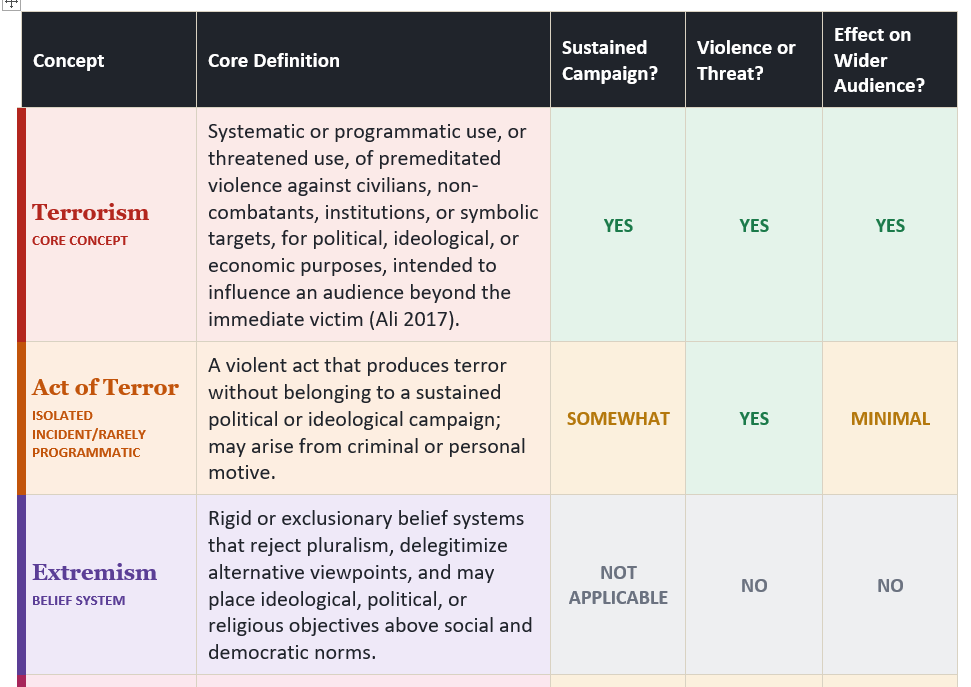
For the purposes of this paper, terrorism is the systematic or programmatic use, or threatened use, of premeditated violence against civilians, non-combatants, public institutions, or other symbolic targets by state or non-state actors, for political, ideological, or, in some circumstances, economic purposes, with an intended effect that extends beyond the immediate victims to influence a wider audience (Ali 2017).[iii] Four elements are essential: intent; violence or the threat of violence; a political or ideological purpose; and the communication of fear to an audience beyond the immediate target (cf. Hoffman 2017).
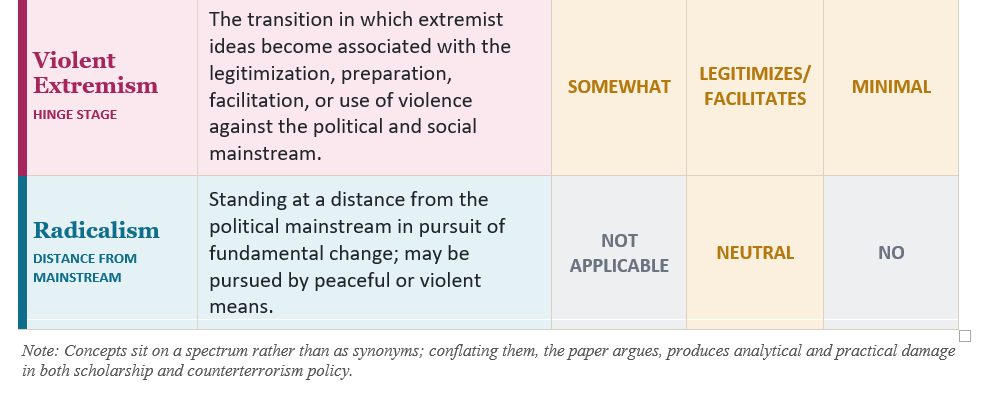
An act of terror need not constitute terrorism. A violent act may produce terror without belonging to a sustained political or ideological campaign. Criminal violence, mass violence arising from personal motive, and violence associated with severe psychological disturbance may terrify without meeting the analytical criteria for terrorism set out above. Distinctively, terrorism has an ideological or programmatic character; an act of terror need not. Extremism refers to rigid or exclusionary belief systems that reject pluralism, delegitimize alternative viewpoints, and may place particular ideological, political, or religious objectives above established social and democratic norms. Extremism per se is not violent, as violence is a behavioral endpoint while extremism is a foundational belief system or an ideational stage. Violent extremism thus marks the critical transition in which extremist ideas become associated with the legitimization, preparation, facilitation, or use of violence as an assault on the political and social mainstream.
Radicalism, by contrast, is simply standing at a distance from that which is mainstream. Radical ideas seek fundamental change and may be pursued by peaceful or violent means. Only in the latter case do they enter the field of violent extremism, and radicalism should not automatically be treated as synonymous with terrorism or extremism. The distinctions are thus not merely for semantic clarity but practical purposes; radical thought is not necessarily extremist, extremism is not necessarily violent, violent extremism is not necessarily an act of terror, and an act of terror is not necessarily terrorism. Prevention and counterterrorism strategies may fail when they treat the entire ideological spectrum as a single security problem and design a single instrument for phenomena that require different responses.
Table 1. Definitional Distinctions Among Terrorism, Act of Terror, Extremism, Violent Extremism, and Radicalism
3. Conceptual Framework: Waves and Generations
The most influential historical approach to modern terrorism remains Rapoport’s (2004, 2022) four-wave model, which identifies an anarchist wave, an anti-colonial wave, a new left wave, and a religious wave, each lasting roughly a generation and each organized around a distinctive international energy. The model remains valuable because it shows that terrorism evolves in relation to broader political and ideological contexts rather than appearing at random. It also has a built-in limit: it is a theory of modern, international terrorism from the late nineteenth century onward, and it does not claim to organize the much longer history of ideologically legitimized political violence.
However, the wave model has itself been contested. Parker and Sitter (2016) for instance, argue that terrorist movements are better understood as persistent ideological “strains”—socialist, nationalist, religious, and exclusionist—that rise and fall in relative prominence rather than replacing one another in sequence, and that Rapoport’s periodization understates continuity and overstates the discreteness of each wave. Kaplan (2010), writing within the wave tradition itself, has separately proposed a “fifth wave” defined by an inward-turning “new tribalism” among small, culturally insular movements. Kaplan’s fifth wave is not the fifth generation proposed in this paper. The two typologies share a numeral but not a claim: Kaplan’s fifth wave describes a retreat from strategic, mass-mobilizing political violence toward apocalyptic or tribal insularity, whereas the fifth generation proposed in this paper describes the opposite tendency—an outward-reaching convergence of theology, political strategy, local governance, and networked mobilization. The terminological proximity is acknowledged here precisely so that it is not mistaken for agreement.
This paper accepts the utility of the wave approach and the force of the strains critique, and proposes a complementary architecture: a generation approach that begins in the first century CE. The purpose is not to deny the specificity of modern terrorism. Dynamite, the mass press, the commercial airliner, and the digital platform each changed what a small group could do. The purpose is to recover earlier configurations that the wave model, by design, leaves outside its frame, and to show how later generations incorporate, adapt, and transform older methods rather than abolishing them. Assassination survives. Guerrilla warfare remains relevant. Religious mobilization persists. State sponsorship has not disappeared. What changes is the combination of these characteristics and the strategic environment in which they operate—a claim closer to Parker and Sitter’s continuity thesis than to a strict succession of discrete eras.
A generation, in the usage adopted here, is a historically clustered configuration of motive, organizational form, and operational environment. Generations overlap; earlier forms do not vanish when a new generation emerges; and not every contemporary organization belongs to the newest generation. The inter-generation claim is narrower and more useful: certain contemporary organizations exhibit a combination of characteristics that the fourth-wave model, taken alone, cannot fully explain. The case material that follows—drawn primarily from the Levant, Persia, and the Horn of Africa and Sahel—illustrates this configuration rather than offering an exhaustive global survey; Section 10 returns to this scope condition.
Table 2. Rapoport’s Four-Wave Model Compared with the Five-Generation Framework
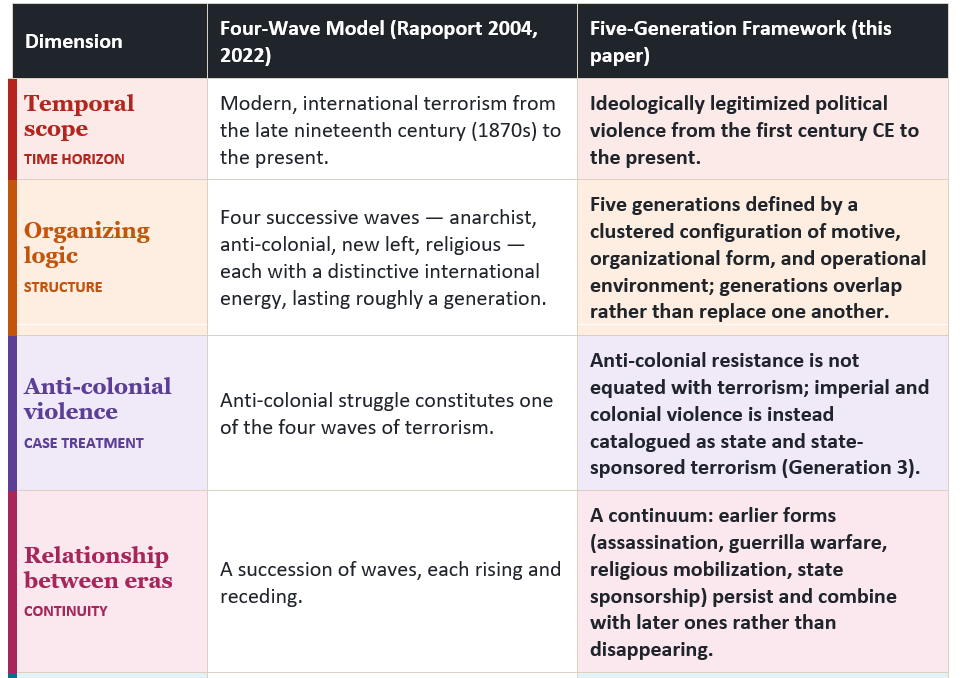

Note: The five-generation framework is presented as complementary to, not a rival of, Rapoport’s wave model; it also engages Parker and Sitter’s (2016) strains critique and distinguishes itself from Kaplan’s (2010) unrelated “fifth wave”.
4. First Generation: Antiquity and Localized Ideological Violence
Some of the earliest recognizable forms of ideologically motivated political violence appear in antiquity. The Sicarii, associated with first-century Judea under Roman rule, remain the clearest illustration (Hoffman 2017). Operating amid intense political and religious contestation, the Sicarii used concealed daggers and struck individuals associated with Roman authority and those regarded as collaborators. Their importance lies less in the body count than in the political purpose of the act: the killing of selected persons could communicate defiance, intimidate a wider population, and demonstrate the vulnerability of an occupying authority. The Sicarii, a relatively weak actor sought political effects disproportionate to its material capacity. The actions were generally acts of terror; they were religiously motivated; and, where they formed part of a sustained campaign directed at an audience beyond the victim, they meet the working definition of terrorism set out above.
The Azariqa faction of the Kharijites[iv] provides a second historical reference from the early Islamic period. Their emergence reflected disputes over political authority, legitimacy, and religious interpretation following the first Muslim civil war (Hagemann 2021). The Azariqa developed exclusionary doctrines of takfir—the declaration of other Muslims as apostates—and employed violence against political opponents whom they regarded as illegitimate or apostate. They illustrate an early and consequential relationship among religious legitimation, contests over rightful authority, and the use of violence against those placed outside the community of the legitimate.
The first generation is therefore characterized by localized operations, limited technological capacity, close-range weapons, and a tight link between political violence and immediate territorial or communal struggle. Some of its episodes are clearly acts of terror; others, where campaign, audience, and purpose coincide, are terrorism. The generation matters because it establishes a pattern that never quite disappears: the attempt by a weaker party to convert a targeted killing into a political message. As Section 8 argues, the fifth generation redeploys this same logic at a vastly extended, glocal scale.
5. Second Generation: Medieval Religious-Political Violence and Institutionalized Asymmetry
The medieval period marks a development in the organization and sophistication of politically motivated violence. The Hashashins, popularly rendered in Western literature as the Assassins, are the emblematic case (Lewis 1967). From the strongholds in Persia and Syria, this religious network built a disciplined organizational structure and employed targeted killings against selected political and military figures. The strategic innovation was not assassination as such; it was the elevation of target selection into an instrument of statecraft by a non-state actor. Rather than attempting to defeat militarily superior adversaries in open war, the Hashashins could impose political costs by removing individuals whose death generated fear, uncertainty, and strategic disruption. This is institutionalized asymmetry: a weaker party organizes itself so that a small number of acts can alter the calculations of a much stronger order.
The same period also shows religious institutions and political authorities employing coercion on a far larger scale. Religious wars, persecution, executions, and campaigns against perceived heresy demonstrate how political authority, religious legitimacy, and organized violence could become tightly intertwined. The second generation is not a story only of the dagger in the crowd; it is a story of the growing fusion of sacred language and organized force, whether the wielder is a sectarian network or a throne.
Relative to the first generation, the second therefore represents a movement from localized acts toward more organized, ideologically legitimized, and strategically selective forms of political violence. The fortress, the chain of command, and the chosen victim replace the improvised dagger as the image of the generation. Modern terrorism inherits both images.
6. Third Generation: Imperial and Colonial Terrorism
The expansion of imperialism transformed the scale and character of state terrorism and political violence. Colonial systems frequently relied on military coercion, collective punishment, forced displacement, economic exploitation, and other forms of systematic violence to establish and maintain political control. The imperial state possessed material power unavailable to most non-state actors and could therefore employ violence and terrorize on a different order of magnitude. Rapoport’s second wave treats violent anti-colonial campaigns as the characteristic form of terrorism in this period (Rapoport 2004). This paper departs from that emphasis: rather than classifying anti-colonial violence as terrorism, it treats imperial and colonial state violence as itself a form of state and state-sponsored terrorism, an object that the wave model, as a theory of non-state violence, does not classify at all.
Anti-colonial movements employed guerrilla warfare, sabotage, assassination, and other irregular tactics. Some deliberately targeted civilians or populations perceived to support colonial rule; others focused on military and government targets. It is essential not to equate all anti-colonial resistance with acts of terror. Historically, most national liberation movements combined conventional and guerrilla warfare with political mobilization.
The third generation matters because it establishes a recurring modern dynamic: the interaction between powerful states and weaker non-state actors using asymmetric strategies, first on an imperial stage and then on a global one. Industrialization, mass communication, nationalism, and imperial competition expanded the political environment in which terrorism operated and reached an audience far from the site of the act. The third-generation terrorism visible here reinforces and underlines the fact of the state’s capacity to label others’ violence as terrorism while leaving its own coercion undescribed. This stance has led to no agreement of one unifying definition for terrorism at the multi-lateral levels and platforms.
7. Fourth Generation: The Modern Religious Wave and Transnational Mobilization
The fourth generation aligns, in its modern phase, with what terrorism scholars have identified as the religious wave, particularly from the late twentieth century onward (Rapoport 2004, 2022). The Iranian Revolution of 1979, the Soviet–Afghan war and the mobilization of foreign fighters into that conflict, the Lebanese civil war, and subsequent geopolitical conflicts solidified an environment in which religious narratives became central to militant mobilization. In several geopolitically significant cases, state actors also instrumentalized religion for strategic purposes, offering sanctuary, resources, or doctrinal cover to organizations that could extend influence without a formal declaration of war.
Al-Qaeda and Hizbullah illustrate different dimensions of the transformation. Religious narrative was no longer a peripheral justification attached to an otherwise secular project; for many organizations, religious identity and theological interpretation became primary sources of legitimacy, recruitment, and mobilization (Rapoport 1984). The generation must not, however, be reduced to Islamism. Religious terrorism in this period has also included violent movements motivated by Christian, Jewish, Hindu, Buddhist, and other religious narratives, a plurality already anticipated in comparative work on terrorism across religious traditions (Rapoport 1984). The analytical center of the generation is the sacralization of political violence and the increasingly transnational character of ideological mobilization, not the monopoly of a single tradition.
Organizations became capable of recruiting across borders, addressing audiences far beyond their theaters of operation, and presenting local conflicts as episodes in a wider ideological struggle. Sophisticated propaganda, expanding networks of non-state violence, and the use of sanctuary states combined to produce a form of terrorism that was at once local in its killing and global in its claim. The fourth generation therefore brought together religious legitimation, transnational mobilization, and a communications environment—cassette, satellite television, and later the first generation of online forums—that allowed a movement to exist in more than one place at once.
What the fourth generation does not yet fully capture is the later combination of theological narrative with local self-financing, proto-governmental practice, franchise geography, and digital cognitive warfare. Those elements appear in embryo. They become constitutive in the fifth generation.
8. Fifth Generation:[v] The Religio-Political, Networked, and Autonomous Era
Fifth-generation terrorism emerges from the accumulated transformations of the preceding four. Its defining feature is not simply religion; religion was already central to much fourth-generation terrorism. The distinctive characteristic is the symbiotic convergence of theology, political strategy, local grievance, organizational autonomy, and networked mobilization.
8.1 The religio-political feedback loop
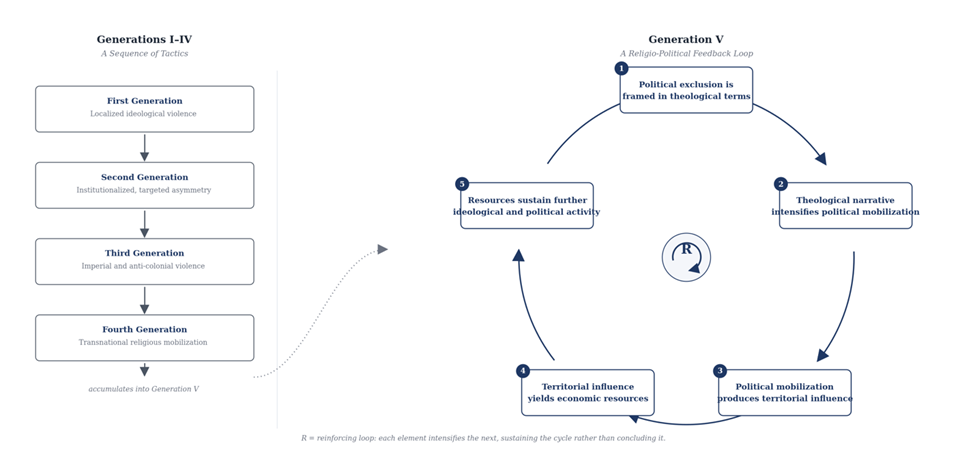
In fifth-generation terrorism, theological narratives and political calculations reinforce one another. Religious ideology can legitimize political objectives, while political grievances provide the concrete contexts in which those narratives are embedded (Crenshaw 1981). The result is a religio-political feedback loop: a movement may frame political exclusion in theological terms; theological narratives may then intensify political mobilization; political mobilization can produce territorial influence; territorial influence can yield economic resources; and those resources can sustain further ideological and political activity. An organization that operates within this loop cannot be understood merely as a clandestine terrorist cell. It is becoming something else: a competitor for authority.
Figure 1. Religio-Political Feedback Loop of the Fifth-generation Terrorism
8.2 Organizational autonomy and the blurred boundary of the state
One decisive characteristic of the fifth generation is increasing organizational autonomy. Some earlier militant organizations depended heavily on external state sponsors, sympathetic governments, or international patrons (Weinberg 2012). Contemporary violent non-state actors can, in a growing number of theaters, generate substantial resources from the environments in which they operate: taxation, extortion, smuggling, illicit economies, control of trade routes, natural resources, kidnapping, local business, and other coercive economic arrangements.
This does not mean that fifth-generation organizations never receive external assistance. It means that greater financial self-sustainability reduces dependence on patrons and, with it, the leverage those patrons once held. In certain contexts, the same organizations perform functions normally associated with states: taxation, dispute resolution, policing, coercion, limited service provision, and territorial administration. Accordingly, the boundaries among terrorist organization, insurgency, criminal enterprise, and proto-government blur. A prevention and counterterrorism policy that insists on a single label will thus misread the object and create a mismatch in strategy.
8.3 From global ideology to localized mobilization
A second defining characteristic of the fifth generation is the relationship between the global and the local mobilization. Organizations associated with transnational movements increasingly operate through localized affiliates, franchises, or networks. Al-Qaeda in the Arabian Peninsula, al-Qaeda in the Islamic Maghreb, Jama’at Nusrat al-Islam wal-Muslimin (JNIM), Harakat al-Shabaab al-Mujahideen (al-Shabaab), Boko Haram, and Islamic State affiliates demonstrate variations of the same phenomenon rather than identical copies of a center.
Local resilience cannot be explained by the appeal of a global ideology alone. Political exclusion, corruption, state abuse, communal insecurity, unemployment, weak governance, competition over land and resources, and unresolved conflict create openings that transnational ideological movements exploit (Crenshaw 1981). This is the paradox of contemporary terrorism: the ideology may be global, but recruitment opportunities are often local, thrusting the problem into a glocal security complex.[vi] The fifth generation is therefore a process of glocalization (Robertson 1995). Global ideological narratives are adapted to local political, social, and economic realities, and the organization becomes more resilient precisely because it can speak to two audiences simultaneously—the local population and the wider transnational ideological community.
8.4 Technology, perception, and the cognitive battlefield
The technological environment introduces a further inter-generational transformation in the realm of terrorism. Digital communication enables violent organizations and extremist movements to communicate, recruit, radicalize, intimidate, fundraise, and disseminate propaganda at unprecedented speed and scale (Sageman 2008). Fifth-generation terrorism therefore extends beyond the physical battlefield. It includes online propaganda and recruitment; encrypted communication; digital radicalization; psychological and information operations; cyber-enabled disruption; remote mobilization; lone-actor violence; decentralized virtual networks; drones and other commercially available technologies; and an increasingly sophisticated use of artificial intelligence and related tools.
Fifth-generation terrorism should not be confused with fifth-generation telecommunications, nor with fifth-generation warfare. In this paper, the fifth-generation terrorism is an evolutionary phase of political violence, not a wireless standard or a doctrine of interstate conflict. Digital connectivity is an enabling environment. The most consequential technological change may not be the ability to destroy physical infrastructure, but the ability to shape perception, manipulate information, and erode social trust. Contemporary extremist actors can seek to create fear without physically controlling territory; they can amplify existing divisions, exploit grievances, and create a sense of insecurity far beyond where violence occurs. The target of terrorism increasingly includes the cognitive and social environment itself, which is one reason the doctrinal literature on fifth-generation warfare has become relevant to the practice of countering fifth-generation terrorism, even though the two terms describe different things.
Traditional terrorism often sought spectacular physical destruction: the bombing of buildings, attacks on transport systems, assassination, or hostage-taking. Contemporary terrorism can still employ all of these methods, but the strategic objective increasingly extends beyond physical casualties. The terrorist seeks an audience. The desired effect may be fear, polarization, political overreaction, loss of confidence in government, communal retaliation, or the perception that the state cannot protect its citizens. A relatively small act of violence can be amplified through social media and global news networks, producing consequences far greater than the immediate damage. The fifth generation therefore combines kinetic and non-kinetic methods; its power lies not necessarily in the number of fighters it possesses, but in its capacity to generate disproportionate psychological, political, and social effects.
8.5 Al-Shabaab, A Case Study of a Fifth-Generation Terrorist Group
Al-Shabaab supplies the clearest illustration of the fifth-generation dynamics described above, precisely because its persistence is otherwise difficult to explain. As Figure 2 shows, the organization fields an estimated 3,000 to 7,000 fighters against a coalition that includes the Federal Government of Somalia’s 30,000-strong national army, roughly 13,000 Somaliland troops, an AUSSOM contingent of 11,900 personnel drawn from five African states, an additional 8,000 to 10,000 Ethiopian troops operating outside the AU framework, and direct military support from the United States, Turkey, Qatar, and the European Union, layered atop billions of dollars in multilateral financing from the UN, World Bank, and IMF. A conventional, force-ratio account of insurgency would not predict the survival of an organization this heavily outnumbered, let alone its capacity to contest and periodically recapture territory. The fifth-generation framework offers an explanation that conventional counterterrorism metrics do not: Al-Shabaab endures not because it can match its opponents’ numbers, but because it has converted itself into something a purely military coalition is not built to defeat.
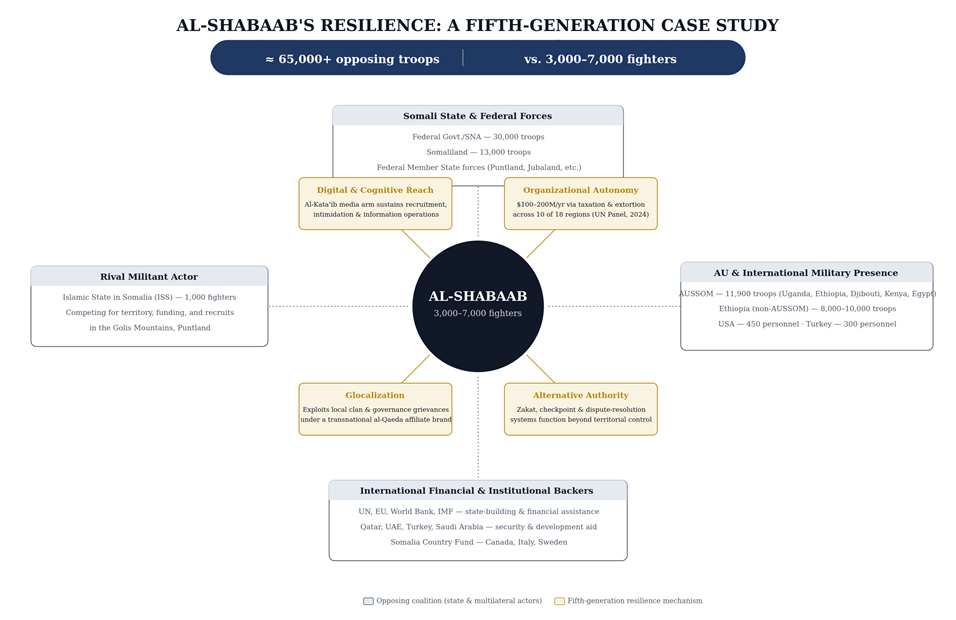
Figure 2. Al-Shabaab’s Resilience as a Fifth-Generation Case Study. Adapted from HORN International Institute for Strategic Studies, “Conflict Actors in Somalia” (April 2025).
The clearest evidence is financial. Where earlier generations of militant organizations in the region depended on state sponsors or diaspora fundraising, Al-Shabaab has built a taxation system that the UN Panel of Experts on Somalia’s 2024 report estimated generated over $150 million in 2023 alone, with other assessments placing annual revenue as high as $200 million, comparable in scale to a significant share of the Federal Government’s own domestic revenue base (UN Security Council 2024; Africa Center for Strategic Studies 2023). This income is drawn from checkpoints, port fees, a 2.5 percent zakat levy enforced by the group’s Amniyat intelligence wing, and taxation of the charcoal trade despite a standing UN export ban, extending across an estimated ten of Somalia’s eighteen regions, including areas where the group holds no permanent physical presence. This is organizational autonomy in the sense the five-generation framework gives the term: financial self-sufficiency that reduces Al-Shabaab’s dependence on any single patron and denies its opponents the leverage that cutting off external sponsorship would otherwise provide.
That financial infrastructure sustains, and is sustained by, a governance function that outlasts any single battlefield defeat. Al-Shabaab’s extraction of taxes from businesses and communities well beyond its zones of military control depends on a parallel system of dispute resolution, registration, and coercive enforcement that residents and traders often find more predictable, if more violent, than the alternative offered by a state whose own agencies the group has substantially infiltrated. This is the glocal logic of Section 8.3 in practice: a transnational al-Qaeda affiliate brand fused to distinctly local grievances, including distrust of the Federal Government, clan-based political exclusion, and contested land and resource access, adapted province by province rather than imposed uniformly. Digital communication and the Al-Kata’ib media apparatus extend this same logic into the cognitive domain, sustaining recruitment, intimidation, and disinformation at a scale that a military campaign focused on territory and troop strength has little capacity to address.
Read together, these mechanisms explain what the opposing coalition’s overwhelming numerical advantage does not: an organization that has been driven out of Mogadishu and stripped of its major port revenues can still generate nine-figure annual income, still adjudicate disputes across ten regions, and still absorb repeated military setbacks without dissolving, because it was never simply a fighting force to begin with. It is, in the terms this paper has proposed, a competitor for authority.
Table 3. Core Dimensions of Fifth-Generation Terrorism
Note: The four dimensions operate together rather than independently; their convergence — not religion alone — is the paper’s central claim about what distinguishes the fifth generation from the fourth.
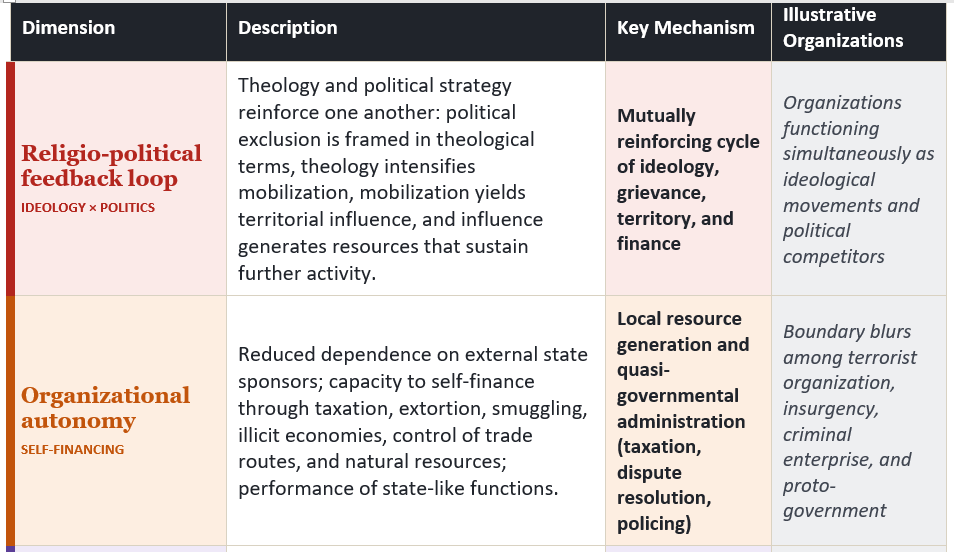
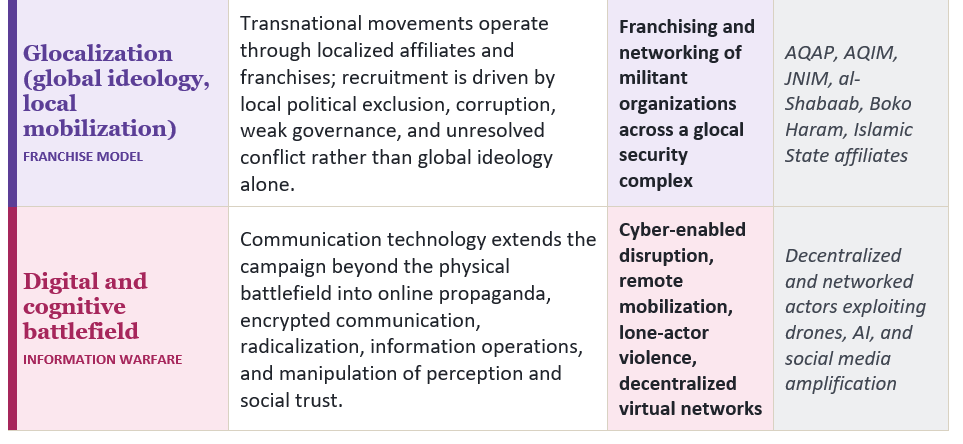
Note: The four dimensions operate together rather than independently; their convergence — not religion alone — is the paper’s central claim about what distinguishes the fifth generation from the fourth.
9. An Evolutionary Continuum
The five generations proposed in this paper are a continuum rather than a sequence in which one generation abolishes another. Assassination survives into modern terrorism. Guerrilla warfare remains relevant. Religious mobilization persists. State sponsorship has not disappeared. Central command structures continue to exist alongside decentralized cells. What changes is the combination of these characteristics and the strategic environment in which they operate.
Table 4. The Five Generations of Terrorism
An analytical schematic summarizing dominant configurations of motive, organizational form, and operational environment across the five generations. Generations overlap; the table describes tendencies rather than exclusive categories.
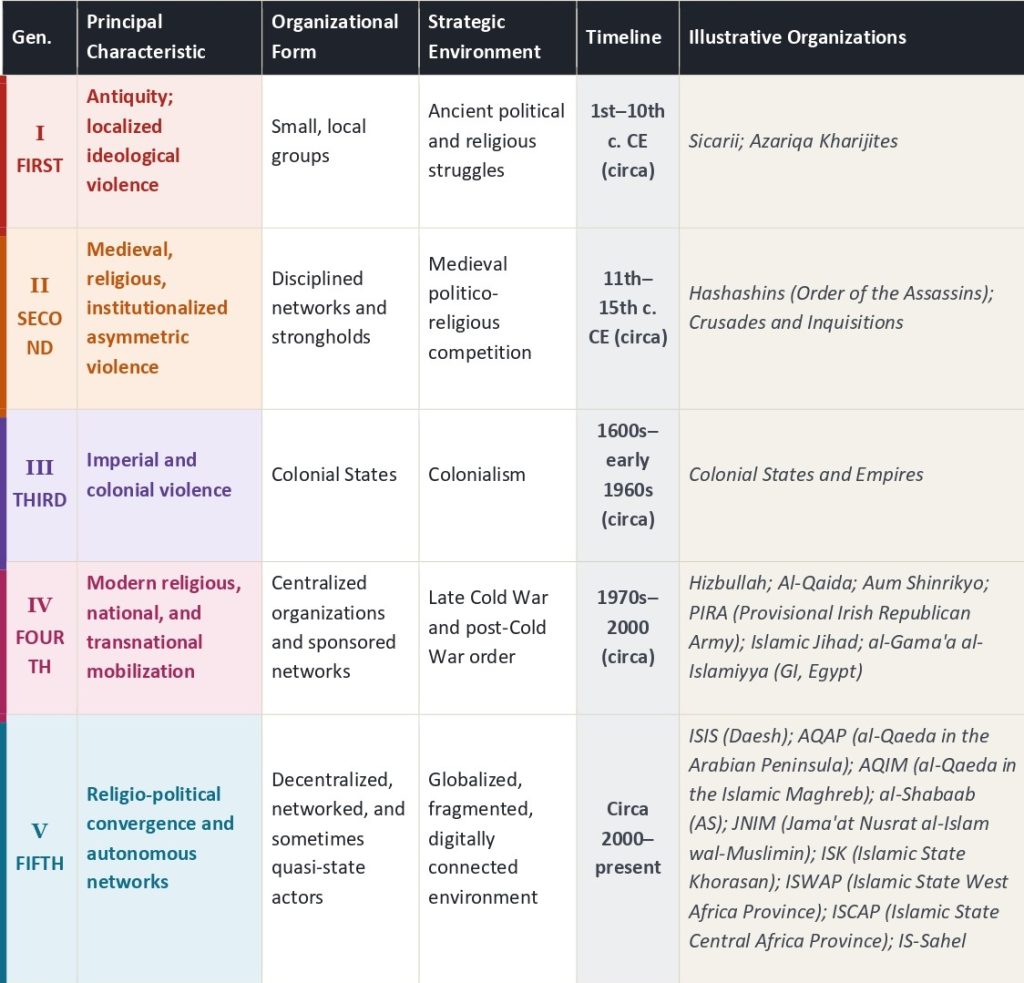
Note: Generations overlap. The table describes dominant configurations, not exclusive membership; contemporary organizations may combine features from more than one column.
10. Scope and Limitations
Two limitations follow directly from the framework’s design and should be stated rather than left implicit. First, the generational boundaries proposed here—like the boundaries of Rapoport’s waves—are heuristic rather than exact. The dates in Table 4 mark the periods in which a configuration became dominant, not periods in which earlier configurations ceased to operate; readers should therefore treat the table as an interpretive aid rather than as a chronology of mutually exclusive eras, consistent with the continuity thesis discussed in Section 3 (Parker and Sitter 2016).
Second, the case material is deliberately illustrative rather than exhaustive, and it draws disproportionately on organizations shaped by Islamist theology and operating in the Middle East, the Horn of Africa, and the Sahel. This concentration reflects where the religio-political feedback loop described in Section 8 is currently most visible and best documented, not a claim that fifth-generation dynamics are confined to one religious tradition or region. Contemporary far-right, ethno-nationalist, and millenarian networks that combine online radicalization, decentralized cells, and, in some cases, territorial or paramilitary ambition may exhibit comparable configurations, and extending the framework to those cases is a task for further research rather than for this paper. The framework is offered as a comparative lens to be tested against such cases, not as a closed inventory of them.
11. Conclusion: Understanding and Countering Fifth-Generation Terrorism
From the localized violence of the Sicarii and other ancient movements, through medieval political-religious violence, imperial and colonial violence, the transnational religious wave, and the emergence of fifth-generation networked organizations, terrorist actors have repeatedly adapted to changes in political authority, technology, ideology, and society. The fifth-generation framework seeks to name the latest adaptation.
Its central proposition is that fifth-generation terrorism increasingly operates at the intersection of religion, politics, local grievance, transnational ideology, organizational autonomy, illicit economies, territorial influence, and digital communication. The critical distinction is therefore not simply between religious and secular terrorism, or between centralized and decentralized organizations. The deeper transformation is the emergence of violent non-state actors capable of functioning simultaneously as ideological movements, political actors, security providers, economic enterprises, social organizations, and quasi-governments, while remaining connected to transnational networks.
This is a new strategic problem. The terrorist organization of the future may not always seek to destroy the state from outside; it may seek to penetrate, compete with, replace, or transform political authority from within contested social spaces. Future terrorism may not always depend on the spectacular attack; it may increasingly seek to manipulate perception, polarize communities, undermine institutional legitimacy, and create persistent insecurity. The evolution of terrorism is also an evolution in the meaning of power.
The fifth generation is not simply another religious wave. It is a transformation into a condition of interlocking pressures in which religious ideology, political strategy, local grievance, organizational autonomy, territorial and economic control, and digital influence mutually reinforce one another. The idea of five generations is not offered as an established consensus in terrorism studies; it is a proposal, advanced in the spirit of Rapoport’s own project, to clarify distinct epochal moments and continuities in the history of terrorism, and to keep terrorism analytically separate from radicalism, extremism, violent extremism, and the act of terror.
The decisive question for policymakers is no longer simply how to defeat terrorist organizations — it is how to prevent violent actors from ever acquiring the political, economic, social, and cognitive footholds that let them become alternative centers of authority in the first place. Understanding this evolution is not academic; it is the difference between counterterrorism that merely reacts to violence and counterterrorism that forecloses the conditions in which the next generation of terrorism takes root. One lesson must be internalized above all: the tools that defeated fourth-generation terrorism will not defeat fifth-generation terrorism. Old playbooks against new threats is a losing strategy. Only fifth-generation countermeasures, purpose-built for fifth-generation threats, can roll back and ultimately defeat the organizations now completing that transformation.
References
Africa Center for Strategic Studies. (2023). Militant Islamist violence in Africa rolls back over a decade of stability. Washington, DC: National Defense University.
Ali, M. Y. (2017). The Globalization of Terrorism: From Sicariis, Assassins to ISIS. Nairobi: The Horn International Institute for Strategic Studies.
Buzan, B., & Wæver, O. (2003). Regions and powers: The structure of international security. Cambridge University Press.
Crenshaw, M. (1981). “The Causes of Terrorism.” Comparative Politics 13 (4): 379–99.
Hagemann, H. (2021). The Khārijites in Early Islamic Historical Tradition: Heroes and Villains. Edinburgh: Edinburgh University Press.
Hoffman, B. (2017). Inside Terrorism. 3rd ed. New York: Columbia University Press.
Kaplan, J. (2010). Terrorist Groups and the New Tribalism: Terrorism’s Fifth Wave. London: Routledge.
Lewis, B. (1967). The Assassins: A Radical Sect in Islam. London: Weidenfeld and Nicolson.
Parker, T. & Sitter, N. (2016). “The Four Horsemen of Terrorism: It’s Not Waves, It’s Strains.” Terrorism and Political Violence 28 (2): 197–216.
Rapoport, D. C. (1984). “Fear and Trembling: Terrorism in Three Religious Traditions.” American Political Science Review 78 (3): 658–77.
Rapoport, D. C. (2004). “The Four Waves of Modern Terrorism.” In Attacking Terrorism: Elements of a Grand Strategy, edited by Audrey Kurth Cronin and James M. Ludes, 46–73. Washington, DC: Georgetown University Press.
Rapoport, D. C. (2022). Waves of Global Terrorism: From 1879 to the Present. New York: Columbia University Press.
Robertson, R. (1995). “Glocalization: Time-Space and Homogeneity-Heterogeneity.” In Global Modernities, edited by Mike Featherstone, Scott Lash, and Roland Robertson, 25–44. London: Sage.
Sageman, M. (2008). Leaderless Jihad: Terror Networks in the Twenty-First Century. Philadelphia: University of Pennsylvania Press.
Schmid, A. P. (2023). Defining Terrorism. The Hague: International Centre for Counter-Terrorism.
United Nations Security Council. (2024). Letter dated 15 October 2024 from the Chair of the Security Council Committee pursuant to resolution 2713 (2023) concerning Al-Shabaab addressed to the President of the Security Council (Document S/2024/748). New York, NY: United Nations.
Weinberg, L. (2012). The End of Terrorism? London: Routledge.
NOTES
[i] The Five Generations of Terrorism: From the Sicarii and the Assassins to ISIS and the Religio-Political Present is a modest contribution of the author’s proposed analytical extension of the existing approaches to understanding the evolution of terrorism. It proposes clarifying epochal moments and continuums, and differentiating terrorism from radicalism, extremism, and the act of terror.The five generations is offered as an analytical framework for the evolution of terrorism since antiquity. It is not presented as an established consensus in terrorism studies. Rather, it is presented as an attempt to explain the changing strategic, organizational, ideological, technological and operational character of terrorism across historical periods. The first four generations run from localized ideological violence in antiquity, illustrated by the Sicarii of first-century Judea and the Azariqa faction of the early Kharijites, through the institutionalized asymmetry of the medieval Hashashins, or Assassins, of Persia and Syria, the structurally paired imperial and anti-colonial violence of the colonial era, and the transnational religious mobilization of the late twentieth century. This fifth-generation terrorism is presented as security challenge that has dominated much of the last 25 years.
[ii] David C. Rapoport’s four-wave model—anarchist, anti-colonial, new left, and religious—is currently widely cited historical approach to modern terrorism. It shows that terrorism evolves with political and ideological context rather than appearing randomly. This paper accepts the utility of the wave approach and proposes a complementary generation approach, beginning in the first century CE, in order to address earlier periods that wave theory, by design, does not cover. Rapoport’s four-wave thesis is useful in the understanding of the modern evolution of terrorism, beginning in the late 19th century, specifically the 1870s. This special paper suggests that terrorism began much earlier and has been a generational challenge to security since antiquity. The paper argues that anti-colonial struggles and wars of liberation do not constitute terrorism, contrary to Rapoport’s thesis. The paper does not argue that earlier waves have disappeared, nor that every contemporary terrorist organization belongs to a new generation. It proposes that certain contemporary organizations exhibit a combination of characteristics that the four-wave model alone cannot fully explain.
[iii] The definition in this paper borrows from the author’s book: Mustafa Y Ali, (2017). The Globalization of Terrorism: From Sicariis, Assassins to ISIS. Horn International Institute for Strategic Studies. The inclusion of state actors is deliberate, and it is the most contested element of the definitional debate noted above with the objection being whether states can commit terrorism. The framework adopted in this paper thus recognizes the force of that objection but not its conclusion. What separates terrorism from armed coercion in general is not the identity of the perpetrator but the structure of the act, premeditated violence against non-combatants intended to communicate fear to an audience beyond the immediate victim,and that structure is available to states and non-state actors alike. Who terrorizes whom, and why? Terrorism’s actor and terrorism’s target together determine its logic, and the two pairings this paper’s definition makes room for four vectors of coercion — state against state, state against non-state, non-state against state, and non-state against the public — are not interchangeable variations on a single theme but four distinct coercive strategies, each with its own mechanism of effect. State actors apply terrorism against other states to compel a desired change in policy or conduct: coercion projected outward, at a rival sovereign’s decision-making, in which the state applying the violence and the state meant to change course are one and the same audience. State actors apply terrorism against non-state actors, by contrast, chiefly to preserve and entrench their own authority: coercion turned inward, in which the object is not to move a rival’s policy but to foreclose challenges to the state’s own claim to a monopoly on legitimate force. Non-state actors mirror this duality from the opposite position of material weakness. Applied directly against the state, their terrorism seeks to influence government policy or compel a specific course of action, in a structure that mimics the state-against-state case even though the correlation of forces runs the other way. Applied against the public, however, non-state terrorism operates through an entirely different mechanism: the immediate victims are not the intended audience but the instrument, and the violence is calculated to manufacture such despondency, fear, and loss of confidence among the population that the state itself is driven, by the pressure of its own frightened citizens, to take the action the non-state actor could never have extracted by force alone. This last vector — indirect coercion, mediated through a terrorized public rather than aimed at the state directly — is terrorism’s most distinctive innovation as a strategy of the weak, and it recurs, in one guise or another, across every generation.
[iv] The Kharijite movement is divided into three factions—Azariqa, Najdat, and Ibadiyya. While the Ibadiyya faction was peaceful in its ideology and actions, the Najdat faction was moderately violent. On the other hand, the Azariqa faction of the Kharijites was extremely violent and practiced terrorism. The Azariqa Kharijites were the first ideological group in the Muslim world to employ systematic takfirism, declaring other Muslims to be apostates, and therefore infidels.
[v] The fifth generation of terrorism is not simply another religious wave. It is a transformation into a security nightmare of interlocking crises—ideological, political, local, organizational, territorial, economic, and digital—in which these elements mutually reinforce one another. It is still unravelling.
[vi] The concept of fifth-generation terrorism requires a new vocabulary adequate to capture the linkages between the global and the local. This paper defines the glocal security complex as a network in which the security concerns and conditions of global and local environments are so deeply intertwined — through shared ideology, financing, digital connectivity, and mobility — that neither can be accurately understood nor durably resolved in isolation from the other. The concept builds on, but departs from, Barry Buzan and Ole Wæver’s (Buzan & Wæver, 2003) regional security complex theory, which bounds security interdependence by geographic proximity. Glocal security complexes are bound instead by structural interdependence, making them the more accurate unit of analysis for actors such as ISIS, al-Shabaab, JNIM, and AQIM. Fifth-generation terrorist actors fit squarely within this understanding: their ideological, financial, and digital networks connect local insurgencies directly to global currents, bypassing the regional insulation that Buzan’s model assumes.
Author Note
This paper is a rewritten and expanded version of the author’s working paper “The Five Generations of Terrorism: From the Sicarii, Assassins to ISIS,” published by the Horn International Institute for Strategic Studies, Nairobi, Kenya. Correspondence concerning this paper may be addressed to Dr. Mustafa Y. Ali at alimustafayusuf@gmail.com.
I am indebted to the Horn Institute team, particularly Mr. Edmond Pamba for editing the paper and Husna Maalim for her work on the infographics and tables.