

September - October 2026 Issue
HORN Bulletin - Volume IX | Issue V |
Authors
Loula Thiebergien, Hossamaldeen Ibrahim, Abdullahi Abdille Shahow, Amal Hamdan, Ph.D,
Abstract
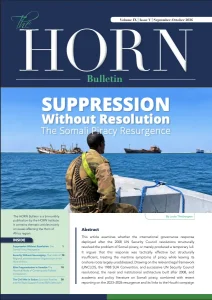
This article examines whether the international governance response deployed after the 2008 UN Security Council resolutions structurally resolved the problem of Somali piracy, or merely produced a temporary lull. It argues that this response was tactically effective but structurally insufficient, treating the maritime symptoms of piracy while leaving its onshore roots largely unaddressed. Drawing on the relevant legal framework (UNCLOS, the 1988 SUA Convention, and successive UN Security Council resolutions), the naval and institutional architecture built after 2008, and academic and policy literature on Somali piracy, combined with recent reporting on the 2023–2026 resurgence and its links to the Houthi campaign in the Red Sea, the analysis shows that the post-2008 response concentrated almost exclusively on maritime deterrence, while state collapse, poverty, illegal fishing, and toxic dumping — the structural drivers of piracy onshore — remained largely untouched. Econometric evidence further suggests that naval pressure displaced piracy rather than eliminating it, a dynamic obscured by the dramatic decline in attacks recorded after 2012. The article demonstrates that when institutional and naval retrenchment coincided with the 2023 Houthi campaign, emerging cooperation between Houthi networks and Al-Shabaab, and, from 2026, the closure of the Strait of Hormuz alongside deep cuts to Somalia’s development assistance, the conditions for resurgence had already reassembled. The article concludes that the 2012–2023 lull reflected changed tactical conditions rather than a resolved structural problem, and that each resurgence should be read as a pause between crises rather than a solved threat. It recommends institutionalizing clear thresholds for scaling naval presence, reforming and broadening regional coordination mechanisms, and, most critically, investing sustainably in the economic viability of Somali coastal communities.