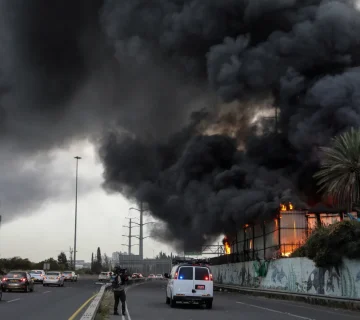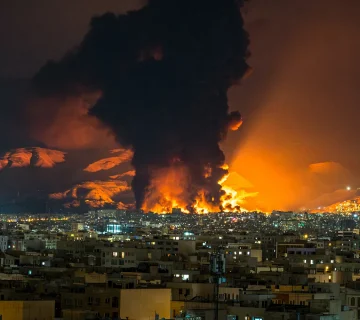
The United States of America (US) and Israel launched a joint military operation on Iran on February 28, 2026, triggering a regional conflict in the Gulf within the first 72 hours. Iran has retaliated with a blitz of missile and drone attacks on UAE, Qatar, Bahrain, Kuwait, and Saudi Arabia, and declared the Strait of Hormuz closed. Tehran’s calculus is deliberate; by targeting perceived US-Israeli allies in the Gulf, it seeks to impose sufficient cost on the region, to push the Gulf states into pressuring the US towards de-escalation. Iran’s Gulf neighbours are yet to retaliate in what appears to be a deliberate restraint policy despite the strategic pressure and pressing security needs. The Horn of Africa, given its historical, economic and geopolitical interlinkages with the Gulf, as well as its geo-strategic location, is a deeply exposed backyard. The region also sits squarely in the blast strike radius of Iran’s 1300-2500km medium range ballistic missiles and hosts US bases in Djibouti and Kenya; hence the success of the Gulf’s restraint calculus remains a key pillar for the security of the Horn of Africa thus far.
The Gulf’s Backyard
The Horn is the Gulf’s most immediate neighbourhood, close enough and deeply interlinked to be swept into any conflagration in the Gulf. At the level of interdependence, the Red Sea in between provides the arterial corridor linking Gulf economies to the Horn’s ports, labour markets, and food supply chains; an estimated 500,000 Ethiopians and 100,000 Eritreans work in Saudi Arabia alone, with a further 100,000 Ethiopians in the UAE and 540,000 Sudanese across Gulf states, approximately a third of the entire Sudanese diaspora. Remittances from these workers are not supplemental income; for many households in the Horn, they constitute the fiscal architecture that finances food, healthcare, and education. The Gulf diaspora represents a significant and existential share of the USD96 billion diaspora remittances into Africa, roughly double the volume of overseas development assistance to Africa.
Gulf investments into the Horn further deepen the Horn’s exposure. Saudi Arabia inked a logistics hub deal with Djibouti in 2024 and expressed interest in developing Eritrea’s Assab Port in 2025. The UAE operates port facilities from Berbera in Somaliland, where DP World holds a USD 442 million development agreement, and previously maintained military logistics facility at Assab Port in Eritrea which initially served as the primary launch point for counter insurgency operations in Yemen. Gulf food security strategies have reinforced these ties through agricultural land acquisitions in Ethiopia and Sudan, creating reverse supply chains that bind Gulf food stability to the Horn.
Pre-War Fractures
The current conflict in the Gulf could not have introduced Gulf rivalries into the Horn; it would have inherited and potentially inflamed a rivalry already destabilising the region. Pre-war, Sudanese forces mainly units from the Rapid Support Forces, provided support to UAE’s counter-insurgency campaign against the Iran-backed Houthis in Yemen. Saudi Arabia also participated in the military operations against the Houthis. The UAE-Saudi Arabia coalition against the Houthi was part of the larger counter-Arab Spring campaign to limit Iran’s influence in the Gulf and the Red Sea, as well as countering the pro-Arab Spring movement including Turkey, Iran and Qatar as of then. The Gulf Crisis 2017-2021 in which UAE, Saudi Arabia, Bahrain and Egypt blockaded Qatar, was partly driven by this geopolitical rivalry which spilled over into the Horn of Africa, destabilizing Ethiopia, Somalia, Sudan, Eritrea and Djibouti.
After the Gulf Crisis, the geopolitical relationship between the Gulf and the Horn has been shaped by the competition and rivalry between UAE and Saudi Arabia (backed by Egypt), the Israel-Palestine conflict, and security interests in the Red Sea. The UAE-Saudi Arabia rivalry has had profound effects in Horn of Africa especially Sudan, where the two have reportedly provided support to opposite sides in the civil war. The proxy confrontation in Sudan has produced one of the world’s worst humanitarian disasters, with over 10 million people displaced. The same zero-sum logic has also been playing out in Somalia and Somaliland, where Qatari, Emirati, and Saudi interests back competing factions.
Israel’s recognition of Somaliland in December 2025, further widened the geopolitical rift in the Gulf, and the larger Middle East, with the Iran-backed Yemeni Houthis threatening strikes on Somaliland. Houthi threats are credible given previous attacks on ships in the Red Sea which exacted cost on Israel during the conflict in Gaza (2023-2025) and pushed the US to intervene militarily to secure navigation along the corridor. Most of the Gulf countries including Iran expressed support for Somalia and rejected Israel’s recognition of Somaliland, except UAE. This is the landscape onto which the Iran war has descended; a region fractured by Gulf proxy conflicts and choked by two critical chokepoints – the Straits of Hormuz and Bab al Mandeb.
The Houthi Variable
One of Iran’s most consequential instruments of regional pressure is its proxy network, especially the Yemeni Houthis. The 2023-2024 Houthi attacks on commercial shipping caused container tonnage through the Gulf to plunge by over 70 percent in two months. Insurance premiums for Red Sea transits rose tenfold, cascading into higher import costs for every Horn country dependent on that corridor. A Gulf entry into direct war with Iran would, with high probability, trigger renewed and intensified Houthi mobilisation, making the Red Sea effectively impassable for Horn trade, severing Djibouti’s port-based economy, and raising food import costs in an already food-insecure Somalia. Intelligence assessments have also flagged that an emboldened Houthi network enhances al-Shabaab’s access to technology and tactics, compounding Somalia’s counterinsurgency burden. Houthis thus pose a credible threat to the Horn of Africa and the Red Sea, which not only can raise the cost of the current conflict on the region but also the global economy.
Restraint as a Buffer
The current Gulf posture, characterized by condemnation of Iran’s ballistic and cruise missile strikes as well as drone attacks, and enhancement of military readiness, without direct retaliation, is not merely a Gulf Cooperation Council survival strategy. It is functioning as a structural buffer for the entire Horn, by limiting the conflict within the Gulf and the Strait of Hormuz. The Gulf’s strategic restraint is halting the escalations and forestalling a wider conflict, thus buffering the Horn of Africa.
First, the restraint policy by the Gulf countries is preventing the Horn of Africa from being conscripted into a larger conflict bestriding both regions. The Horn of Africa has previously served as pipeline of mercenaries for the Gulf as was the case with Sudanese forces in Yemen. At a time when the recruitment of the region’s youth into the war in Ukraine as mercenaries is spreading, the likelihood of more youth if not regional forces being involved in the war, would have been high.
Restraint has also been a key driver of the emerging solidarity within the Gulf, which is bridging the pre-war cleavage between UAE and Saudi Arabia, and diminishing its destabilizing impact on the Horn of Africa. In such environment of restraint, Iran’s proxy, particularly the Houthis, have not been able to activate their destabilizing networks with the Somalia-based Al Shabaab extremist group, nor have they launched attacks on ships in the Red Sea to exact a higher cost.
It is thus urgent for decisionmakers in Nairobi, Addis Ababa, Mogadishu, and Djibouti, to maintain a deterrent posture, which leverages on the Gulf’s restraint, pursues strategic neutrality, diversifies commodity supply chains, and enhances military and naval readiness as well as alliance networks to ensure security in the Red Sea. The region should further fortify the buffer by maintaining support for diplomatic efforts to the end the conflict in the Gulf.
Photo Credits: Al Jazeera