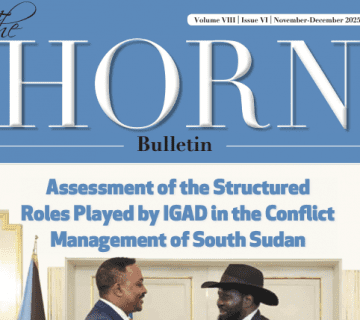
This edition of the HORN Bulletin presents four analytically rich articles examining the evolving geopolitical, technological, and conflict dynamics shaping the Horn of Africa and its wider strategic environment. The contributions interrogate interstate relations, emerging technological competition, external power rivalries, and humanitarian consequences of protracted conflict, collectively highlighting the complex interaction between governance, security, and regional resilience.
The first article, “Landlocked Geopolitics and Peacebuilding: Rethinking Ethiopia–Eritrea Relations,” examines the Ethiopia–Eritrea relationship through the theoretical framework of the security and foreign policy dilemmas facing landlocked states. The study argues that Ethiopia’s loss of maritime access and Eritrea’s strategic control of Red Sea ports have produced enduring structural asymmetries that sustain mistrust, strategic misperception, and fragile cooperation. Tracing relations from the 1998–2000 border war to the 2018 rapprochement, the article demonstrates that personalized diplomacy alone cannot sustain peace without institutional mechanisms. It emphasizes that durable stability depends on institutionalized interdependence through corridor diplomacy, legally grounded transit arrangements, and cooperative sovereignty frameworks capable of transforming competition over port access into mutually beneficial regional integration. Ultimately, the article concludes that embedding bilateral cooperation within regional and international legal regimes offers a pathway toward long-term peace and economic resilience in the Horn of Africa.
The second article, “Corporations, Governments and the Artificial Intelligence (AI) Race: Towards a People-Centered AI,” explores the global competition surrounding artificial intelligence and its implications for governance, economic transformation, and societal wellbeing. The authors argue that the contemporary AI race is largely driven by corporate profit motives and geopolitical rivalry among major powers, particularly the United States and China, often sidelining public interests. The article highlights risks including job displacement, algorithmic bias, surveillance expansion, and growing technological inequality. It calls for a people-centered AI governance model grounded in human rights, inclusivity, transparency, and equitable access to technological innovation. Emphasizing reskilling initiatives, multilateral cooperation, and ethical regulatory frameworks, the study proposes a balanced approach that aligns technological advancement with social protection and democratic accountability.
The third article, “Conflict by Proxy: Gulf Rivalries and Strategic Influence in the Horn of Africa,” analyses how competition among Gulf states has transformed the Horn of Africa into an arena of external geopolitical contestation. While Gulf engagement is frequently framed as peace mediation or economic partnership, the article demonstrates that strategic rivalry, maritime security interests, and economic expansion largely drive intervention. Gulf involvement—through military cooperation, infrastructure investment, and political alliances—has reshaped local conflict dynamics, intensified militarisation, and weakened regional governance structures. The study argues that proxy engagement risks prolonging instability by empowering domestic actors and externalizing regional conflicts. It recommends strengthening regional agency through coordinated diplomatic positions, enhanced leadership by the African Union and IGAD, and more transparent, development-oriented partnerships that prioritize community-level stability over elite geopolitical competition.
The fourth article, “An Appraisal of the Dynamics of Darfur Conflicts: Impacts on the Livelihood of Affected Populations,” examines the structural and proximate drivers of the Darfur conflict and their profound humanitarian consequences. The article situates violence within longstanding governance failures, environmental pressures, ethnic marginalization, and competition over land and resources. It demonstrates how cycles of armed confrontation have devastated livelihoods through displacement, destruction of agricultural systems, loss of economic opportunities, and deepening food insecurity. By linking conflict dynamics to socio-economic vulnerability, the study underscores that sustainable peace in Darfur requires inclusive governance reforms, strengthened protection mechanisms for civilian populations, and integrated recovery strategies addressing both security and development needs.
Collectively, this issue of the HORN Bulletin underscores that contemporary security challenges in the Horn of Africa are increasingly shaped by structural interdependence between domestic governance crises, external geopolitical competition, technological transformation, and environmental pressures. The edition highlights the urgent need for institutionalized cooperation, inclusive governance models, and regionally led peacebuilding frameworks capable of navigating an increasingly complex and multipolar security landscape.