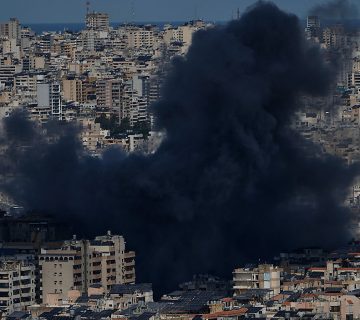
The United States and Israel are conducting military strikes under Operation Epic Fury on Iran since February 28, 2026. Iran’s response has been immediate, wide-ranging and instructive, firing ballistic and cruise missiles as well as Shahed drones at US military installations across nine Gulf countries. Bahrain, Kuwait, Qatar, Saudi Arabia, the United Arab Emirates, Jordan, Iraq, Oman have been targeted in Iran’s retaliatory attacks. Besides US military bases such as Al Udeid Air Base in Qatar, the US Navy Fifth Fleet headquarters in Bahrain’s Manama, Ali Al Salem Air Base in Kuwait, Al Dhafra Air Base in the UAE, civilian infrastructure including oil refineries and storage facilities, airports and hotels were also struck.
However, none of these countries are involved in a direct war with Iran. Iran has nonetheless made them legitimate targets for hosting US military bases and assets, from which Iran also perceives some of the US strikes are coming. Second, Iran seeks to escalate cost on both the US and these countries, to pressure for de-escalation. The Gulf hosts of US bases are thus exposed by proxy. For the African countries hosting foreign bases especially in the Horn of Africa, conflict in the Gulf is a live stress test of every assumption that underpins their foreign base bargain.
How Militarised is Africa?
At least 13 foreign powers have military presence in Africa, with the US alone operating across 34 outposts across Africa. China, the UK, Italy, Japan, Germany, Turkey, the UAE, Saudi Arabia and Russia all maintain military facilities or access arrangements in Africa. The Horn of Africa with 11 foreign military bases is the epicentre of this militarization and Djibouti, with a population of one million people and eight (8) foreign bases, is arguably the most militarized real estate in the world. Djibouti hosts the largest US military base on the continent, Camp Lemonnier, for which the US pays about USD70 million in annual rent. France shares its base with Italy, Spain, and Germany in Djibouti, while the East Asian rivals, Japan and China, have their first overseas military bases in Djibouti. Saudi Arabia also maintains military logistics presence.
Eritrea hosted UAE and Russian facilities; Russia was in talks to establish another off Sudan’s Red Sea coast. Somalia hosts a Turkish military training facility in Mogadishu, while its break-away region of Somaliland hosts a second UAE base. Kenya hosts British bases since independence from Britain in 1963, alongside US bases at Camp Simba in Manda Bay, which hosts US naval personnel, Green Berets and armed drone assets for operations in Somalia and Yemen. As such, four out of the five Horn of Africa countries have foreign military bases, accounting for over 10 foreign military bases, and additional negotiations are underway.
A Forgone Conclusion
Under the adversarial assumption of equal belligerence, African countries hosting foreign bases are exposed and risk being co-belligerents in future armed conflicts. But this is not hypothetical. UAE’s Assab base in Eritrea was used in the Saudi-led coalition campaign against Iran-backed Houthi rebels in Yemen, creating an adversarial relationship for Asmara with Iran and the Houthis. Kenya’s Camp Simba has faced blowbacks from al-Shabaab which. Djibouti’s rejection of Russia’s request for a base, citing the risk of becoming “a terrain of proxy war”, is an acknowledgement of the same structural reality. The question is no longer whether Africa risks exposure by hosting foreign bases but what African host states must demand to manage that exposure.
Security Guarantees
Gulf host states have survived Iran’s missile and drone campaign better than they might have, because of years of investment in layered air-defense systems. Qatar’s Al Udeid, the largest US air base in the Middle East, is absorbing Iranian strikes with the protection of Patriot missile batteries, THAAD terminal defense systems, radar networks, cyber-intelligence integration, and coalition-coordinated interception. African host states have no comparable arrangement, hence should negotiate for comprehensive security guarantees and formal mutual defense commitments including real-time intelligence sharing, deployment of defensive systems and treaty-level obligations from the base owners.
Consultation on Major Operational Decisions
The Gulf host states did not, by most accounts, receive substantive prior notice that Operation Epic Fury was imminent. Weeks of US-Iran negotiations gave the impression that military action remained a distant option. When strikes began on February 28, Gulf capitals scrambled to close airspace, alert populations and activate their air defense systems. For African host states, the consultation gap is likely even wider. African countries must demand more than post-decision notification; prior briefings on planned major operations, assessments of escalation risk, and explicit host-state consent are necessary to enable such countries to prepare adequately to manage escalation risks.
Codified Strategic Autonomy
Perhaps the most instructive aspect of the Gulf crisis is what the host states have refused to do. Despite enormous pressure from factions within the US including Senator Lindsey Graham, pushing Gulf states to join offensive operations, and from Iran’s own attacks, the Gulf states have maintained strategic restraint. They condemned Iran’s strikes but declined to retaliate offensively. This demonstrates Gulf states rejection of the binary logic of the conflict by which they would play into Iran’s trap. The Gulf states are also demonstrating policy independence from the US by not following the US into war.
African countries hosting foreign bases should equally cultivate strategic autonomy, by ensuring the primacy of regional order and stability and leveraging the political capital that comes with regional economic communities such as the Intergovernmental Authority on Development (IGAD) as is the case with Gulf Cooperation Council (GCC).
The African Union’s Peace and Security Council in April 2016 called for member states to be “circumspect” when subscribing foreign base agreements. However, no continental consensus on binding modalities exists leaving individual states to negotiate bilaterally, from positions of economic dependence, without the leverage to codify autonomy. Codified strategic autonomy may also include limits on the scope of engagement, and the right to order the suspension of operations and usage.
The Window is Open
The conflict in the Gulf has created a rare moment for African countries with similar arrangements to geopolitically renegotiate. Base-owning countries are reassessing, extending and in some cases retreating from arrangements across the globe. France has withdrawn from Niger, Mali and Burkina Faso while the US closed its Agadez drone in Niger following the 2023 coup. Such agreements must reflect African agency based on security guarantees, consultation rights, strategic autonomy and the primacy of regional order and stability.
Photo Credits: Getty Images.